

Media · Validated action

Acts, not clicks.

Here, your media budget only goes out after the action happens: the video watched to the end, the survey answered, the referral completed. Every action validated by rule, and every transaction with an audit trail on blockchain.

The problem

You pay more and more for attention. And still have no guarantee of behavior.

In Brazilian pre-roll, only 38% of people watch the ad to the end (Kantar, Inside Video 2025). Meanwhile, CPM keeps getting more pressured as more brands compete for the same attention. More budget in the race. Little guarantee that attention turns into valuable behavior.

01

The market's ruler has already shifted once.

Measurement is moving away from exposure KPIs, like impression and viewability, toward attention metrics: time-in-view, engagement depth. Wibx operates on the next ruler after that one: it does not measure how long the ad stayed on screen, it pays only for the completed action.
02

And the market anchoring this shift is already worth billions.

Retail media moved R$4.8 billion in Brazil in 2025, growing +37% a year (IAB Brasil/Ibope, Digital Adspend 2026, base year 2025). The economic base to turn media into behavior already exists.

The inversion

Instead of paying to interrupt, create a reason to act.

At Wibx, the reward is not the final product of the strategy; it is the instrument that produces a verifiable action. Advertising stops being just a message and becomes a measurable experience: people become live channels of media, sales and engagement, based on real actions.

And the loop closes exactly where your finance team likes it: what the audience exchanges with the brand returns to its wallet and can recirculate into the next campaign. Exchange is sale: one event, two effects. You are not buying an interaction; you are creating an action that produces behavior now and fuels the next activation.

There is still a territory exposure media does not see: post-purchase. Whoever already bought tends to vanish from the campaign's economic radar. The interval between one purchase and the next action is measurable territory for relationship, referral and recurrence. The thesis is not to replace your media; it is to make media produce behavior that returns to your wallet.

01

Do the math in behavior.

A campaign has, hypothetically, R$100 thousand for activation. In exposure logic, the evaluation ends at reach, impression and click. At Wibx, you define the action: watch, refer, answer, complete a signup, make an exchange. If 20 thousand people qualify for the mechanic and 5 thousand complete the action, you have 5 thousand validated behaviors, not an estimate of people exposed. The unit changes: from estimated audience to verifiable behavior.

The real math depends on the rule, the caps and the contracted design. The example shows the mechanic, it does not promise performance.

The mechanics

The question is not "which format is more creative?". It is: what behavior do you need to provoke?

Four media mechanics on the same engine. You define the behavior; the system organizes the mechanic; validation records the event and only then releases the reward: this is the Proof of Behavior.

01

The skipped ad costs zero.

For content that needs to be actually consumed: music, video, podcast, live. Whoever watches 40 seconds of a 1-minute goal generates no cost: only the completed action counts, and only it becomes a reward.

Play

02

Recommendation with a face.

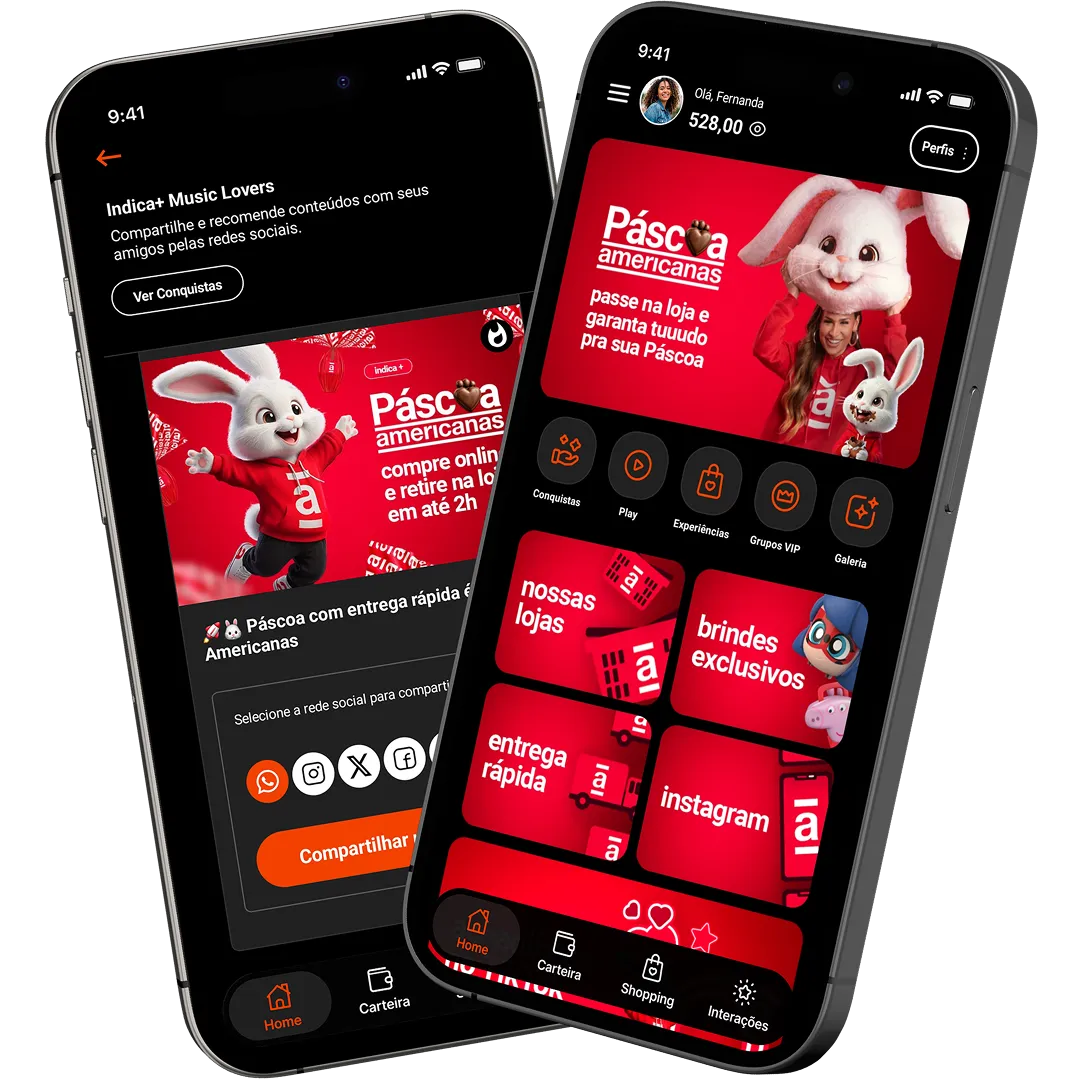
Turns recommendation into measurable action, P2P advertising, never abstract reach. The reward is for the sale actually made, set in the campaign rules, with caps per campaign and per user.

Refer+

03

The data no cookie delivers.

Surveys, quizzes and ratings, rewarded. The brand captures the two signals the market chases most: declared data, zero-party data the person voluntarily states, added to the first-party behavioral data of the executed action. Privacy-first collection by design, consented at the source, ready for the cookieless world.

Click & Answer

04

The base brings the next base.

Member Get Member: acquisition pulled by the user's own network, with double reward: both the referrer and the person who arrives win. The unit is not the invite sent; it is the validated action the campaign defined, from click to effective signup.

MGM

Ranking is a layer, not a mechanic: competition on top of any of them, with reward by goal, no luck involved. Push is a communication and reactivation tool: it delivers the message to the user; the mechanic is what defines the action.

What gets measured

A report the CFO likes.

The ruler does not end at the number of participants. There are four reading levels: from operational to network effect.

01

Execution.

The campaign ran according to the rule: participation, completion, redemption, signup, with cost per execution and a trail.

02

Performance / campaign ROI.

CPA, LTV, uplift, cost per action, conversion: the reward enters the same financial logic you already use to evaluate acquisition and retention. And the reading is fixed: ROI is always the campaign's and the advertiser's budget, never the token's.

03

Distribution and network effect.

Breaks social bubbles, share rate, conversion by network: did the behavior stay restricted to the first user, or did it find a network able to multiply it?

04

Impact.

The level at which the ecosystem reveals patterns: WIBX distributed by impact category and social telemetry.

01

The CFO panel.

Caps per campaign and per user. Total WIBX allocated per period and per campaign. Distributed versus balance. Effective cost per validated action. Anti-fraud trail. You define how much can be distributed, to whom, in which campaign and under which rules. It is not unlimited reward; it is an economic unit of behavior with an explicit financial limit.

Underneath it all, the record: configurable rules per campaign and a transactional trail on the enterprise layer. The technology named for what it does: proving the action happened under a defined rule.

The proof

What happened when this ran for real.

Americanas · first controlled test (Apr/2026)

61.6×

more views

21.3 million versus 346 thousand for the conventional post

84.2%

of the 3,560 users in the sample performed at least one registered interaction

US$0.10

per paid engagement

Result observed in this test (Apr/2026), not an expected rate. The number demonstrates what happened in that test, it is not a promise of future performance.

The limits

What this media does not do, on purpose.

Every limit below exists so the number that reaches the report is a validated-behavior number, easy to defend.

01

Does not charge for a sale it did not measure.

If there was no validated action, there was no cost. The economic unit is the registered behavior, never the estimate.

02

Does not promise reach.

You contract verifiable action, not audience projection. What the campaign delivers is in the audit trail, not in the adjective.

03

Does not hide who is recommending.

P2P advertising is identified: whoever refers appears as the one referring. The recommendation comes with a face, that is where the trust comes from.

04

Does not promise zero fraud.

The anti-fraud system, validated over millions of real records, performs detection and mitigation; no system guarantees zero fraud. A behavior platform is only commercially useful if it distinguishes valid participation from activity that should not generate a reward.

Ready to pay only for what happened?

Understand the model with no commitment, and only then talk to the team.

If there was Wibx, there was validated action.

FAQ

Questions from buyers

No. Wibx is a behavior layer on top of the stack you already have: CRM, e-commerce, POS and martech. The question it adds to your operation: how much of your media can produce a verifiable, reusable action?

Through validation, not declaration. The system records the event according to the mechanic's criteria and only then releases the reward.

No. The interface is Web2, a regular app experience, frictionless. Blockchain works at the value and record layer (Ethereum and Hyperledger Besu), as a transactional audit trail. Your team sees dashboard and report; the proof stays recorded.

No. WIBX is a utility token: it operates rewards, exchanges and redemptions inside the ecosystem. It is not an investment, not a security, and does not guarantee financial return.

Yes, by design. Caps per campaign and per user, total allocated per period, distributed versus balance and effective cost per validated action, all on the dashboard. You define how much, for whom, in which campaign and under which rules.